News for Nur. Stuff that's neat.
Section: Dinosaurs
Saturday, October 24, 2026

Utah's badlands give up another new dinosaur species

Posted by Captain Queso on Saturday October 24, 2026 @5:59PM in Dinosaurs
from the another-one-out-of-the-sandstone dept.

Utah keeps doing this: you turn your back on a stretch of sandstone for five minutes and it hands over a new species. The segment is short on anatomy, so treat it as the headline and watch for the paper with the proper name and the cladogram.

A short FOX 10 video report on dinosaur fossils excavated in Utah that researchers say belong to a species new to science. Local coverage of the dig in southeastern Utah describes the site as holding several different kinds of dinosaur.

A 99-million-year-old lizard caught shedding its tail, in amber

Posted by Captain Queso on Saturday October 24, 2026 @12:58PM in Dinosaurs
from the leave-it-behind dept.

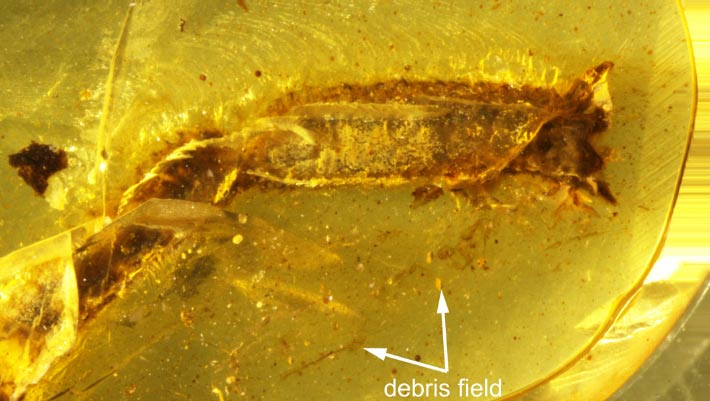
No dinosaurs this time, but the next best thing: a Cretaceous lizard frozen mid-escape in Burmese amber. Behaviour almost never fossilises, which is what makes this tiny tail-drop so satisfying; the trick it shows is one modern geckos still pull on cats.

Researchers describe a piece of Myanmar amber, about 99 million years old, preserving evidence that a lizard deliberately dropped part of its tail. It is a rare fossil record of caudal autotomy, the defence lizards still use to escape predators.

One Brazilian bone says herrerasaurids outlasted the world that made them

Posted by Captain Queso on Saturday October 24, 2026 @6:59AM in Dinosaurs
from the last-carnivore-standing dept.

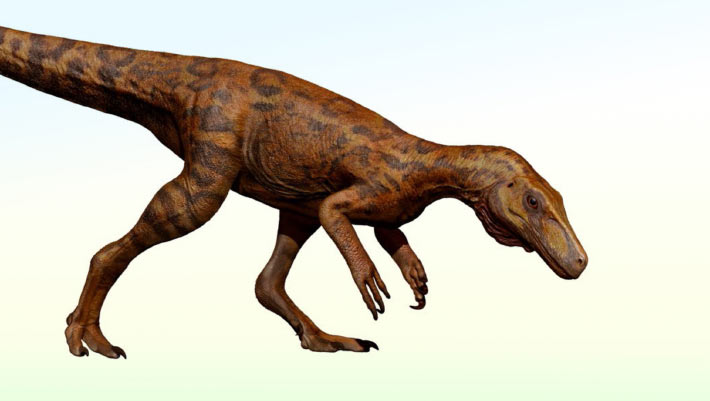
Herrerasaurids are about as close to the root of the dinosaur family tree as anyone gets, so even a single bone carries a lot of weight here. The interesting bit is not the predator itself but the ecosystem around it: the plant-eaters and cynodonts shifted, and the early meat-eaters apparently just carried on.

A Sci.News report on one fossil fragment from southern Brazil's Triassic rocks, identified as belonging to a herrerasaurid, one of the earliest large predatory dinosaur groups. Its age suggests these animals persisted after the surrounding fauna, including the cynodont Exaeretodon, had changed.
Friday, October 23, 2026

A 518-million-year-old fossil suggests the starfish ancestor waved tentacles

Posted by Captain Queso on Friday October 23, 2026 @9:54PM in Dinosaurs
from the reach-for-the-stars dept.

No dinosaurs tonight, but this goes much further down the family tree. The textbook picture of a worm-like burrower at the root of the starfish and acorn-worm lineage takes a knock from a Chinese Cambrian fossil. Worth noticing how much a single well-preserved soft body can rearrange a branch of the tree.

Researchers describe Yujingia glutenotunica, an early Cambrian ambulacrarian from China. Its anatomy points to a common ancestor of starfish, sea urchins and their kin that sat in the water feeding with tentacles, rather than burrowing through sediment like a worm.

Watch a 75-million-year-old dinosaur being freed from its rock in Raleigh

Posted by Captain Queso on Friday October 23, 2026 @5:54PM in Dinosaurs
from the some-assembly-in-reverse dept.

Most of palaeontology happens long after the dig, with dental picks and air scribes and a great deal of patience, and usually behind a closed door. Raleigh is putting that slow work in front of the public. Late Cretaceous, so a few million years older than the museum's famous T. rex.

A large block holding a roughly 75-million-year-old dinosaur has been moved into the North Carolina Museum of Natural Sciences in downtown Raleigh. Visitors will be able to watch as the fossil is gradually prepared out of the stone.

A new T. rex cousin shakes up the tyrannosaur family tree

Posted by Captain Queso on Friday October 23, 2026 @2:45PM in Dinosaurs
from the family-reunion-gets-awkward dept.

Every few years a new tyrannosaur turns up and the family tree has to be redrawn in pencil again. This one is billed as a relative of T. rex that doesn't sit where the textbook says it should. The pool only carried the headline, so the details of which bones and which branch are behind the link.

New Scientist reports the discovery of a newly identified relative of Tyrannosaurus rex. According to the report, the find challenges the accepted account of how the tyrannosaur lineage evolved.

Big Chunky, the fattest belemnite on record, from Wyoming's Jurassic sea

Posted by Captain Queso on Friday October 23, 2026 @1:59PM in Dinosaurs
from the calamari-bulk dept.

Not a dinosaur, but it swam above their heads, and the nickname alone earns it a slot. Belemnites are the bullet-shaped squid cousins every fossil shop sells by the bucket, which makes a barrel-shaped one from a family thought long gone all the more fun. Worth noticing: the shape hints at a different lifestyle, perhaps hunting smaller cephalopods.

Researchers have described the stoutest belemnite yet found, a squid relative from the seas that covered Wyoming about 160 million years ago. The rare fossils show a barrel-shaped animal unlike known belemnites, possibly a predator of smaller squid-like creatures and a late survivor of a lineage thought to have died out.

Musango, a new Late Triassic sauropodomorph from the shore of Lake Kariba

Posted by Captain Queso on Friday October 23, 2026 @9:19AM in Dinosaurs
from the lake-kariba-park dept.

Fresh dinosaur news from somewhere that rarely makes the headlines: Zimbabwe, 210 million years ago. The interesting bit is not the skeleton itself but the argument that Zimbabwe's early dinosaurs were a different crowd from the ones down south, possibly because the climate differed. The story is written by the lead palaeontologist himself.

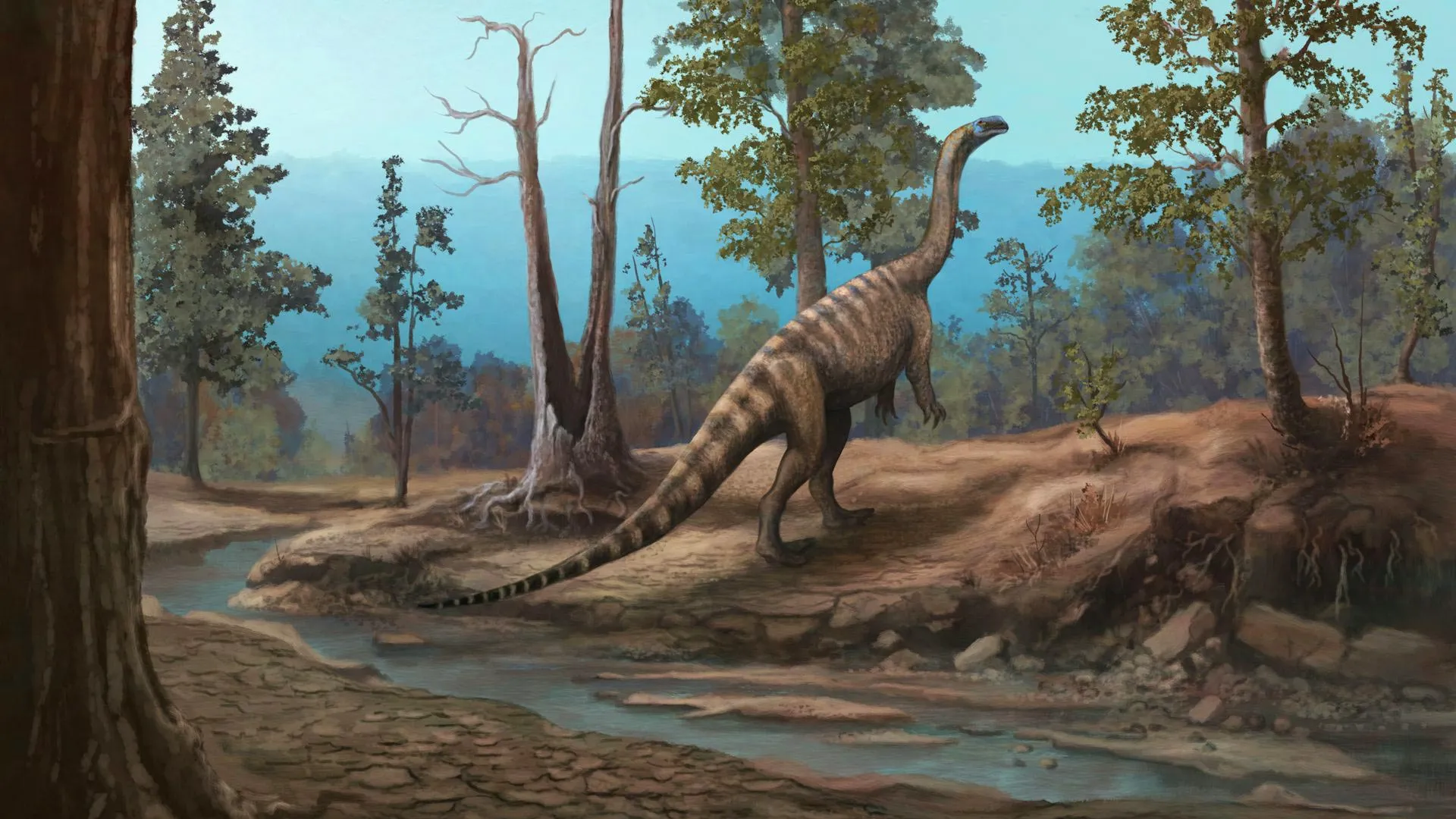
Paul Barrett of the Natural History Museum and colleagues describe Musango matusadonaensis, a two-legged plant-eater about 4.5 m long known from a partial skeleton found on a riverbank in Matusadona National Park. Growth rings show it was not fully grown. Along with Musankwa, named in 2024, it suggests the Late Triassic dinosaurs of Zimbabwe differed from South Africa's.
Read the rest of this story (ScienceDaily (via The Conversation))

Crocodile relatives have followed the warmth for 245 million years

Posted by Captain Queso on Friday October 23, 2026 @9:18AM in Dinosaurs
from the snowbird-archosaur dept.

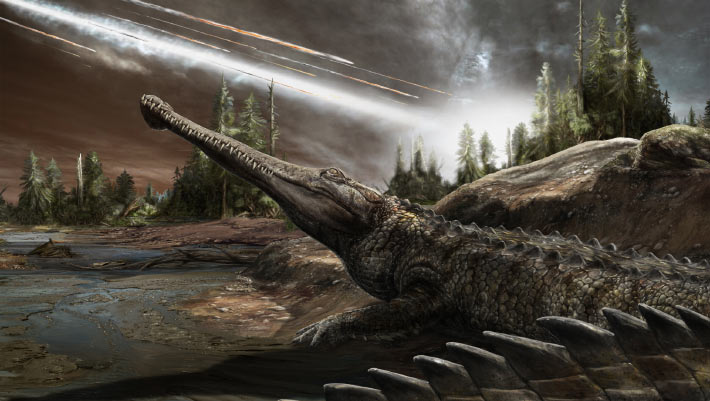
The other branch of the archosaur family tree gets its turn. A UCL team argues that crocodile-line reptiles never really adapted to new climates; they just moved whenever the world warmed or cooled. That same habit may be why they made it through the asteroid when their dinosaur cousins did not.

Alfio Alessandro Chiarenza and Philip Mannion combined a tree of over 400 pseudosuchian species with thousands of fossil sites and living-crocodile records. They found the group kept a stable preferred climate, around 23 C for the ancestor, and shifted range rather than adapting. Climate models of the end-Cretaceous aftermath show warm refuges near the equator that could have sheltered them. The study is in Science Advances.

Infernogallus, a parrot-jawed Hell Creek dinosaur that may have eaten fruit

Posted by Captain Queso on Friday October 23, 2026 @2:49AM in Dinosaurs
from the five-a-day-in-the-cretaceous dept.

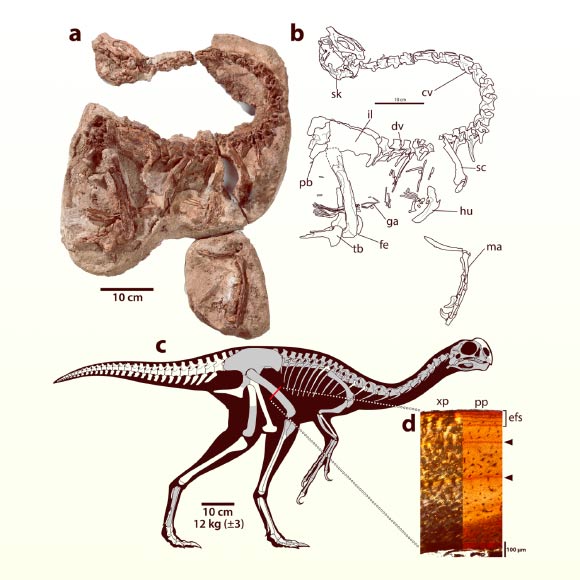
Hell Creek is T. rex country, so it is a nice change to meet a 12 kg neighbour with a weak bite and a sliding jaw that probably preferred fruit. The comparison to a living parrot is the bit that makes it click. Also a reminder that a nearly complete skull can sit in a collection for over a decade before its story gets told.

Researchers describe Infernogallus jamesi, a toothless oviraptorosaur from the very end of the Cretaceous in Montana and the Dakotas, from a near-complete skull collected in 2011. CT reconstructions of its jaw muscles point to a gentle, slicing bite, and with no gizzard stones found, the team argues for a soft, fruit-heavy diet. The paper is in Nature Communications.

Tooth marks suggest small raptors scavenged a dead young tyrannosaur

Posted by Captain Queso on Friday October 23, 2026 @1:49AM in Dinosaurs
from the leftovers-again dept.

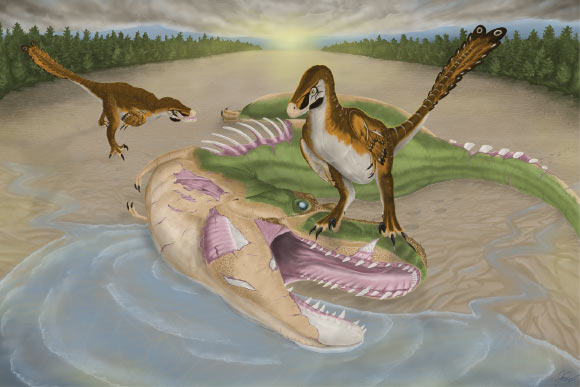
Forensic palaeontology at its finest: researchers measured serration spacing in bite marks, corrected for the angle of the bite, and named a likely suspect. The size gap makes the case, since a turkey-sized raptor was not taking down a half-tonne tyrannosaur, but it would happily clean up after one.

A jaw from a young Albertosaurus, about 70 million years old from Alberta, carries scrape marks matching the teeth of the dromaeosaur Atrociraptor. At an estimated 16 to 18 kilograms against roughly 530, the biter was probably feeding on a carcass rather than hunting. The study appeared in the Journal of Paleontology this month.

One small vertebra may be the oldest dinosaur from Iberia

Posted by Captain Queso on Friday October 23, 2026 @1:48AM in Dinosaurs
from the back-bone-of-the-algarve dept.

Not every dinosaur find is a skeleton; sometimes it is one 37 mm bone that moves a timeline by tens of millions of years. Worth noticing how much careful phylogenetic work can hang on a single centrum, and how honest the authors are about not naming it.

A vertebra from Late Triassic rocks near Loulé in southern Portugal, over 220 million years old, is the first Triassic dinosaur material from the Iberian Peninsula. Analysis places it among early neotheropods, closest to England's Sarcosaurus, but the bone is too incomplete to name a new species.

A megaraptor in a museum drawer: Britain's first long-clawed predator, a century late

Posted by Captain Queso on Friday October 23, 2026 @1:17AM in Dinosaurs
from the filed-under-misc dept.

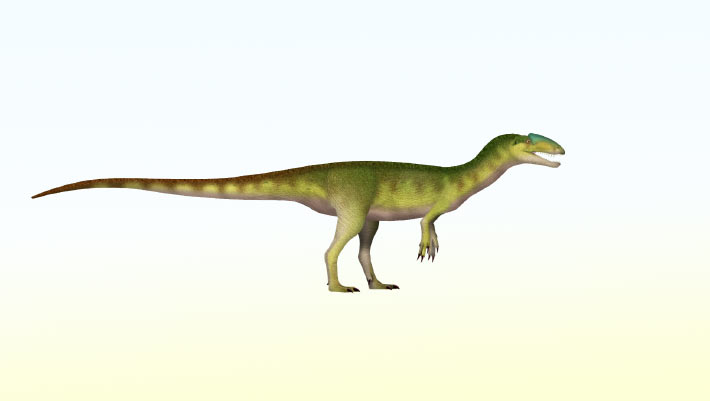
Proof that the best fieldwork sometimes happens in a storeroom. A scrap of skull the museum bought in 1924 turns out to be the first megaraptoran ever found in Europe, which redraws the map for a whole family of big-clawed hunters. Bonus points for a name that translates as unconquered female warrior.

Researchers from UCL and the Natural History Museum have named Invictibellatrix amberina from a partial skull collected on the Isle of Wight by amateur collector Reginald Hooley. The animal lived about 120 million years ago and was roughly 3 to 4 metres long. The find suggests megaraptorans ranged widely early on, then faded out in the northern continents while their southern cousins became top predators.
Read the rest of this story (Natural History Museum)